The Mount Pleasant Lithium Issue // Mobile Installation
Stop replacing batteries.
Upgrade the cart.
When a lead-acid pack starts getting weak, you are not limited to buying more of the same. Lithium can make the cart lighter, extend useful driving range, charge faster, and remove the monthly maintenance routine.
$2,150Typical starting price installed
Cart and system dependent
Cart and system dependent
01
The upgrade changes more than the battery.
More confident range
Strong, consistent power supports longer neighborhood use without constantly wondering whether the cart has enough charge left.
Faster charging
Spend less time planning around the charger and more time actually using the cart.
A lighter, more responsive cart
Removing substantial battery weight can improve acceleration, efficiency, handling, and suspension load.
Consistent power delivery
Instead of feeling weaker as the pack drains, lithium is designed to remain stronger and more predictable through the charge cycle.
02
More information. Less maintenance.
No watering. No acid cleanup. No battery guesswork.
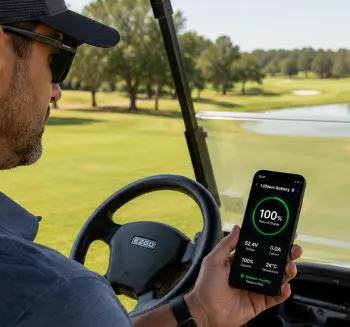
Our preferred lithium system includes Bluetooth monitoring, allowing you to check charge level, battery status, performance, and charging activity from your phone. You gain visibility while eliminating the routine that makes lead-acid ownership burdensome.
03
Lead-acid replaces the pack. Lithium changes the experience.
Ownership factorLead-acidLithium
MaintenanceWater checks, cleaning, corrosion careMaintenance free
ChargingSlower chargingFaster charging
WeightHeavy multi-battery packSignificantly lighter system
PowerCan fade as charge dropsMore consistent delivery
MonitoringMostly guessworkBluetooth app visibility
04
The right moment is usually when replacement is already approaching.
Lithium makes sense when…
Your batteries are weak, aging, slow to charge, or unreliable—and you use the cart enough to value range, lower maintenance, and dependable performance.
We will tell you when it does not.
The goal is not to sell every owner lithium. We inspect the cart, match the correct battery and charger, and recommend the conversion only when it fits the cart and how you use it.
05
Meet the LOSSIGY system we install.
Our preferred lithium golf cart conversion uses the LOSSIGY 48V 100Ah lithium iron phosphate system with Bluetooth monitoring, a charger, and a battery monitor. It pairs everyday convenience with professional installation matched to your cart.
| Chemistry | Lithium iron phosphate (LiFePO4) |
|---|---|
| Voltage / capacity | 51.2V nominal / 100Ah, for compatible 48V electric carts |
| Stored energy | 5.12 kWh (5,120Wh) nominal |
| Battery management | Integrated 200A BMS; controller demand and operating limits checked before installation |
| Monitoring / charging | Bluetooth plus the selected kit’s monitor and compatible lithium charger |
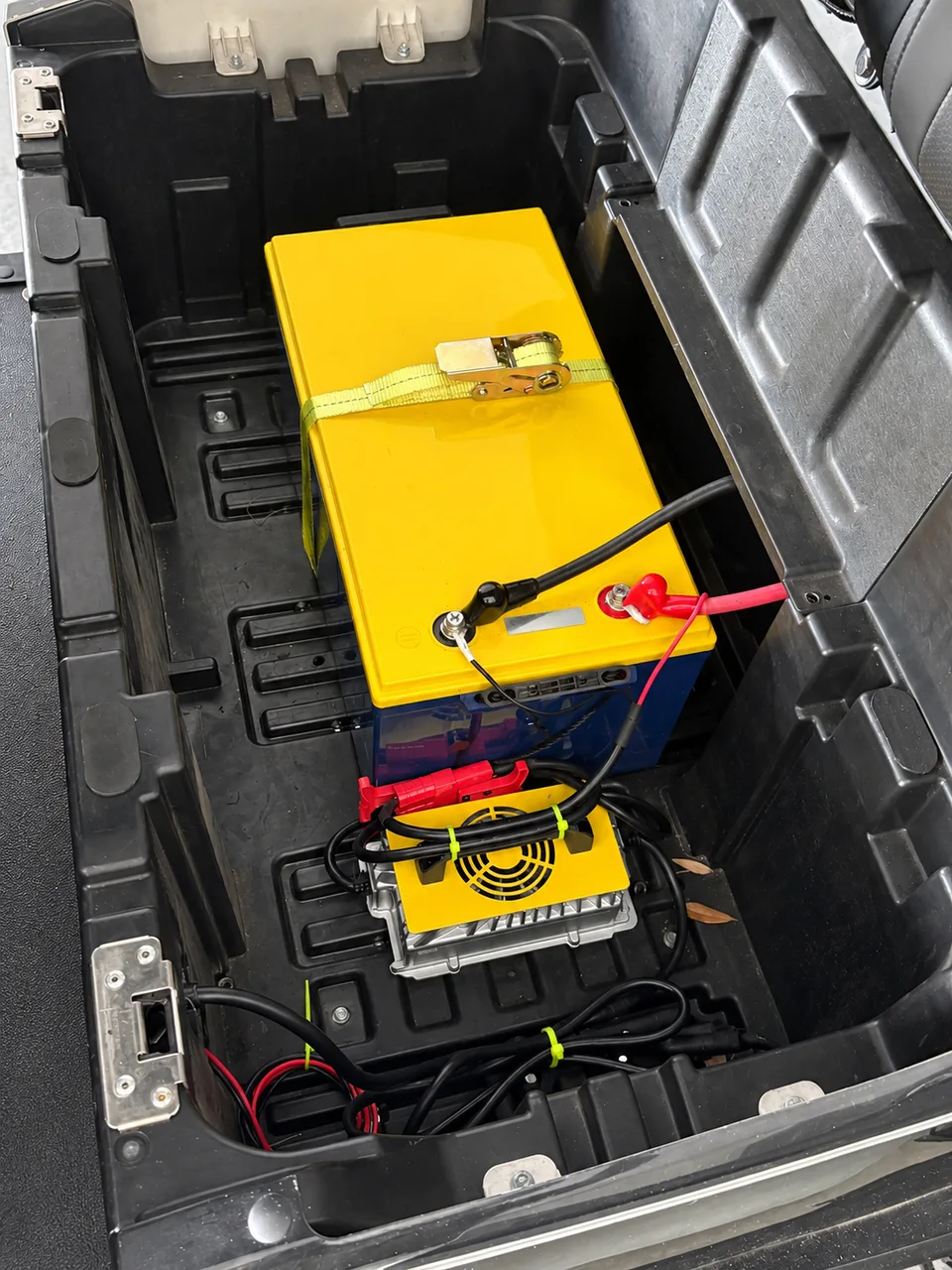
Around $2,150 installed means more than a battery in a box. Your quote accounts for the cart and its installation needs, which may include mounting, cabling, charging connections, accessory integration, and final operational testing. We confirm the equipment and work included before proceeding.
We offer lithium upgrades rather than conventional replacement lead-acid packs, with mobile golf cart battery installation in Mount Pleasant, Sullivan’s Island, Isle of Palms, Daniel Island, and nearby Charleston-area communities.
Core specifications: LOSSIGY 48V100Ah product information. Exact equipment and operating instructions depend on the kit supplied.
06
Your questions, before and after the upgrade.
Open any question for practical answers about range, charging, compatibility, and ownership.
How far can I drive on a full charge?
Range depends on your cart, load, and driving conditions. Dividing the system’s 5,120Wh of nominal energy by consumption gives these illustrations:
| Energy used per mile | Nominal-energy calculation |
|---|---|
| 100Wh | About 51 miles |
| 125Wh | About 41 miles |
| 150Wh | About 34 miles |
| 175Wh | About 29 miles |
| 200Wh | About 26 miles |
These calculations assume all nominal energy is available; operating limits and a sensible reserve reduce usable mileage. They are not manufacturer range ratings. Lift kits, oversized tires, hills, higher speeds, passengers, and accessories can substantially increase consumption. Plan around your cart’s results, not a 50-mile promise.
How many hours can I drive before recharging?
Driving time depends on mileage and average speed. Twenty miles at 10 mph is two hours of driving; 30 miles at 10 mph is three hours; 30 miles at 15 mph is two hours. These are time-and-distance examples, not runtime guarantees.
A neighborhood outing may last much longer than the time the motor is running. Parking and stops differ from continuous driving, although accessories may still use power.
How long does charging take—and must I charge every night?
You can recharge before the battery is empty. Whether you need to charge each night depends on the charge remaining and your next trip.
If your installed kit has a compatible 18A charger, 100Ah ÷ 18A gives about 5.6 hours before allowing for charging taper and balancing. For planning, allow roughly 1.5–2 hours from 75%, 3–3.5 hours from 50%, 4.5–5 hours from 25%, or 6–7 hours from nearly empty.
These are estimates, not factory charging-time guarantees. Check the supplied charger’s rating; a different output changes the timing. Temperature and battery condition also matter.
Can I check the battery from my phone?
Yes—the selected system includes Bluetooth monitoring. Within Bluetooth range, you can check battery information without opening the compartment.
Depending on the battery and app version, readings may include charge level, voltage, charging or discharging current, temperature, cell information, and protection alerts. You spend less time on battery maintenance while having more information about its condition.
Does a lithium battery need maintenance?
No watering or electrolyte checks—but basic care still matters. Lithium eliminates flooded lead-acid watering, acid-residue cleanup, and equalization charging.
Keep the compartment clean and dry, inspect visible cables and connections, and follow charging and storage instructions. Connections can still loosen or corrode; have damaged or overheated wiring inspected professionally.
Can I leave it charging overnight?
Follow the instructions for the battery and charger supplied with your installation. Charging controls and the BMS manage charging within their operating limits, but that does not establish permission to leave every kit plugged in unattended.
Check the supplied instructions before making overnight charging your routine. Leaving a charger connected for weeks or months is a separate storage question; do not assume it is recommended.
What if I do not use the cart for several weeks?
Prepare it for storage instead of parking it with a low battery. Battery electronics and connected accessories may continue drawing power while parked.
Follow the installed model’s storage charge level and temperature instructions, switch off or disconnect accessory loads as appropriate, and check charge periodically. Avoid leaving it deeply discharged. Use the supplied manual for the specific storage percentage and checking interval.
How long will it last, and what if something goes wrong?
Longevity depends on use and care; a particular number of years is not guaranteed. LOSSIGY advertises 4,000+ cycles under specified test conditions for its 48V100Ah product. A cycle represents cumulative use equivalent to a full discharge and recharge, not every time you plug in.
Calendar aging matters too. Heat, discharge depth, charging habits, and storage affect service life. For an unexpected shutdown, warning, or charging problem, contact us with the app message and battery details. Stop using the cart if anything seems abnormal.
Confirm warranty coverage for the kit and purchase channel on your quote. LOSSIGY’s published five-year limited warranty policy applies to eligible direct-website purchases by the original purchaser; it is not an automatic promise of coverage for every installed kit or installation labor.
What does the built-in BMS do?
The Battery Management System monitors battery conditions and provides protective controls. LOSSIGY describes protection against overcharging, excessive discharge, overcurrent, short circuits, and temperature-related risks.
The 200A BMS designation is not a blanket compatibility guarantee. Correct cable sizing, overcurrent protection, charging equipment, and a match to the controller remain essential. Protection shutdown should not be your normal signal to recharge.
Will lithium make my golf cart faster?
It may feel more responsive, but a higher top speed is not guaranteed. Reduced battery weight and steadier voltage can improve acceleration compared with an aging lead-acid pack.
Maximum speed still depends on the motor, controller, gearing, tire size, and programming. A battery conversion does not replace a motor or controller upgrade.
Can I keep using my existing charger?
Only if its compatibility is verified. A flooded lead-acid charger may use an unsuitable charging profile, including equalization modes that should not be used with this lithium system.
The selected kit includes charging equipment. We check the charging setup during installation; retaining existing charging ports or onboard components depends on the cart.
Will this system fit my golf cart or LSV?
We check the vehicle before recommending the conversion. Compatibility depends on system voltage, motor and controller demand, battery-space dimensions, mounting, charging connections, accessory wiring, and battery operating limits.
Send your electric golf cart or LSV’s manufacturer, model, and approximate year. For an eligible on-site conversion, mobile installation means you generally do not need to arrange a trailer or transport.
07
A simpler battery-care routine.
This general checklist complements the factory instructions supplied with your exact battery and charger.
- Charge correctly. Use the compatible lithium charger and recharge before routinely reaching BMS shutdown.
- Respect temperature limits. Follow the installed model’s charging and discharging limits. Do not charge below its minimum charging temperature unless that system explicitly supports it.
- Prepare for storage. Follow factory storage charge guidance, manage accessory loads, and check charge periodically.
- Keep connections in good condition. Keep the compartment clean and dry; avoid unnecessary water or chemicals. Have loose, damaged, or overheated connections inspected.
- Pay attention to alerts. Check the app and investigate unusual warnings rather than repeatedly resetting or bypassing protection.
Keep your supplied instructions handy. LOSSIGY also provides manuals and app guidance; use only documentation matching your installed model.
Mobile lithium installation // Mount Pleasant and nearby communities
No trailer. No hauling. No guessing what to buy.
We come to you, install the lithium system, configure it correctly, and test the cart before the job is finished.
Call or Text 843-568-5936Estimates vary by cart, battery capacity, passengers, terrain, accessories, charging habits, and driving style.